
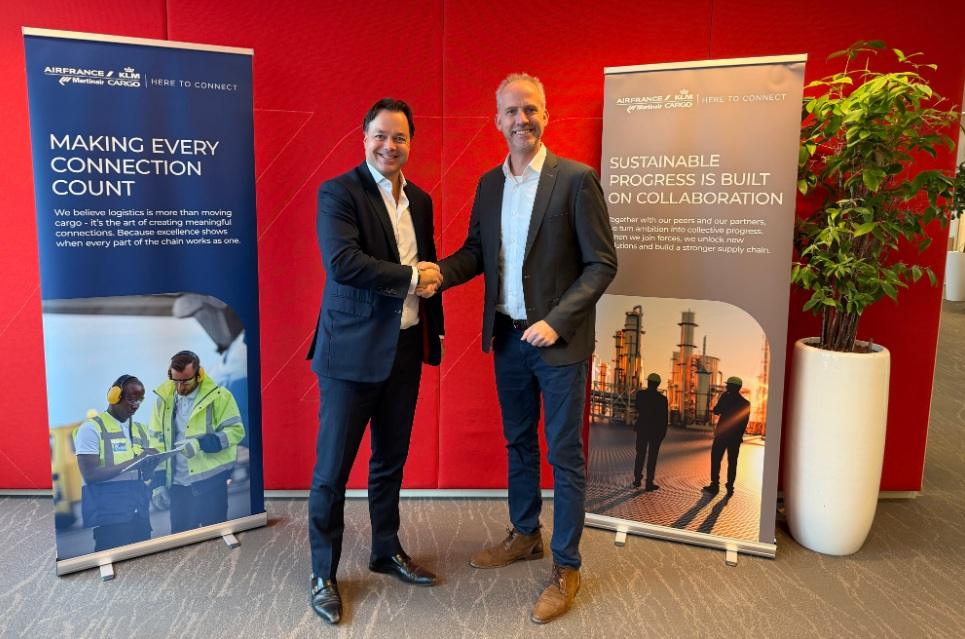
Logistics giant Deutsche Post DHL Group’s air and ocean freight business DHL Global Forwarding announced a new agreement with Air France KLM Martinair Cargo (AFKLMP), expanding their collaboration to the use of emissions reduction rights to help DHL decarbonize air freight and meet its sustainability goals.
The new announcement follows an initial agreement between the companies in 2022, with DHL purchasing 33 million liters of sustainable aviation fuel (SAF) AFKLMP. Under the new agreement, DHL announced that it signed a work order for 35,000 metric tons of CO2e Well-to-Wheel emission reduction rights, with the companies highlighting the partnership’s expanded focus on developing long-term approach to accelerate the adoption of sustainable aviation fuels and digital verification processes in the marketplace.
GertJan Roelands, SVP Commercial at Air France KLM Martinair Cargo, said:
“We are proud to renew this partnership with DHL Global Forwarding, a clear sign of leadership. Our shared ambition and continued collaboration on SAF are fundamental to scaling the solutions needed to reduce the carbon footprint of the air freight industry. This new agreement reflects mutual trust, operational commitment, and a firm belief that only through close cooperation can we drive meaningful change across the air freight value chain.”
According to DHL, the new agreement will play a central role in towards its goal to increase the use of sustainable aviation fuels to 30 percent by 2030, by enabling measurable emission reductions and paving the way for standardized, globally applicable market mechanisms.
Henk Venema, Executive Vice President of Global Air Freight at DHL Global Forwarding, said:
“This framework agreement shows what collaborative decarbonization in air freight can look like. Emission Reduction Rights provide predictability, scalability, and transparency – three critical factors for sustainable aviation fuels to make a real impact within the market. Together with AFKLMP, we are establishing a foundation that can serve as a model for the entire industry.”