TotalEnergies CEO Patrick Pouyanné said that the company will reduce its planned investments in clean fuel capacity, based on his prediction that the EU will not stick with its mandated targets for required sustainable aviation fuel (SAF) use.
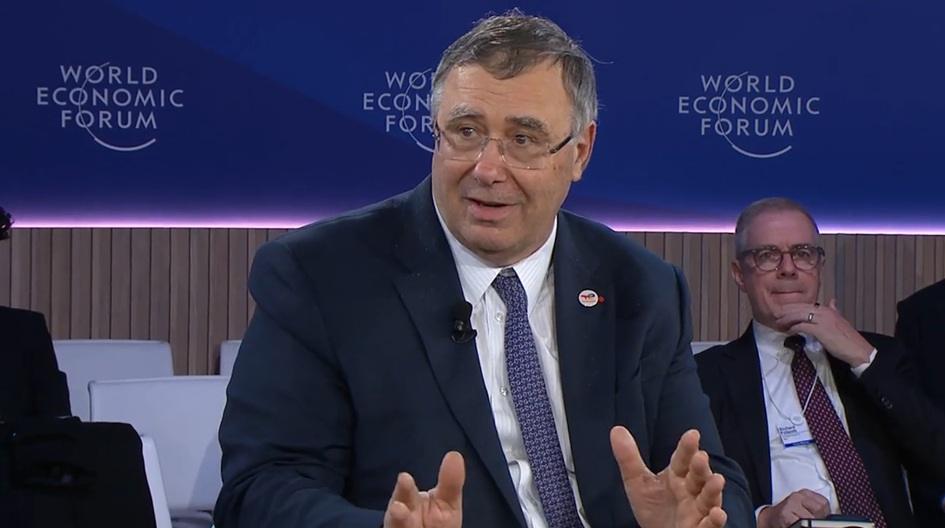
Pouyanné statement, made Wednesday during a panel discussion on clean fuels at the WEF annual meeting in Davos, follows the recent announcement by the European Commission that it will remove its requirement for a 100% reduction in CO2 emissions from new cars and vans from 2035, replacing it instead with a requirement for carmakers to meet a 90% tailpipe emissions reduction target.
Pouyanné said:
“I will make a bet today. What happened to the car regulation will happen to the SAF regulation in Europe.”
The EU’s ReFuelEU Aviation regulation, passed in 2023, sets rules requiring a minimum share of SAF at EU airports, starting a 2% in 2025, jumping to 6% in 2030, and increasing over time to reach 70% by 2050.
Following the agreement by EU lawmakers in 2023 on the SAF mandates, TotalEnergies announced that it is “investing massively” to grow its capacity, setting targets to scale production of sustainable aviation fuel to reach capacity of 500,000 tons per year by 2028, and a goal to produce 1.5 million tons per year by 2030.
In his remarks at Davos, however, the CEO warned that uptake of clean fuels required regulatory mandates, as companies are unwilling to pay up on their own for biofuels, which are significantly more expensive to produce than oil-based fuels.
Pouyanné said:
“Without regulation, there is no market.”
Pouyanné highlighted aspects of the EU’s SAF regulation that he viewed as problematic, most notably the lack of a gradual increase in mandated SAF levels, which are set to jump from 2% to 6% in 2030, which he said would require the company “to overinvest during 5 years just to reach 6%.”
The CEO added that “all the airline companies are fighting” the 2030 6% mandate,” and that the regulation’s subsequent targets “just make zero sense… so we’ll be obliged, I’m sure, to revise.”
Pouyanné said that while the airlines are accusing the company of not investing enough to meet the SAF requirements, the company would have “no problem to invest” and could even provide 10% SAF to the airlines by 2030, but added that “it has a cost, and everyone is dreaming to have this biofuel and clean fuel for the same price as oil.”
Based on his prediction that the EU will water down the SAF mandate, Pouyanné said:
“I will invest less in this thing. I’m afraid that as it’s a regulated market, if they move the targets… the I will have invested in biorefineries for nothing.”
Pouyanné also said that investments in renewable energy presented a much more compelling business case in terms of decarbonization impact, noting that “solar, wind today, in terms of cost of abatement for CO2, it costs $200 per ton of CO2, while biofuels are more like $350, $400 per ton.”
Pouyanné said:
“The real objective is, how do you provide the most affordable and sustainable as possible energy.”