
• First engineered carbon removal supplier to deliver half a million Puro.earth certified certificates with thousand year permanence
• One of the largest operational CCS projects linked to ethanol production, achieving ratings recognition from BeZero Carbon
• Comes as the voluntary carbon market seeks high integrity removal and verifiable permanence at scale
Gevo has issued more than 500,000 engineered carbon removal certificates from its North Dakota plant, marking one of the largest deliveries of verifiable, thousand year carbon removal credits to the voluntary market. The certificates, known as CORCs, are certified under the Puro Standard and reflect carbon permanently stored through carbon capture and storage infrastructure directly linked to ethanol production.
Operational Delivery at Scale
Gevo began carbon capture and storage operations at the North Dakota site in June 2022. According to the company, the plant has now issued CORCs in volumes not yet common in the engineered carbon removal market, where corporate buyers continue to struggle with limited delivery and high project risk.
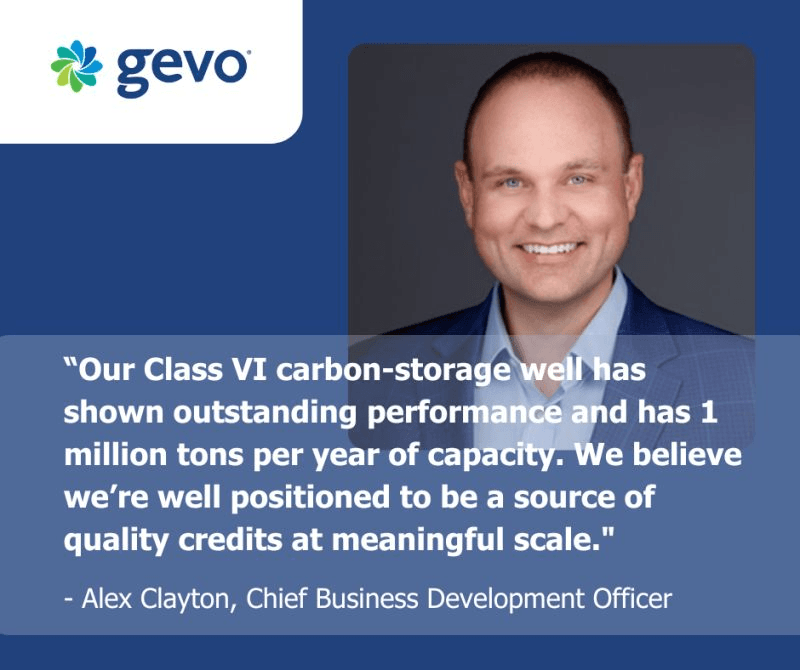
“Gevo designed its carbon business to operate with integrity at scale across regulated low carbon fuel markets and voluntary markets,” said Alex Clayton, Chief Carbon Officer at Gevo. “By applying Puro.earth’s industry leading standards for CCS and maintaining strict controls to prevent double counting, we have been able to deliver high quality carbon removal consistently and credibly. Reaching 500,000 CORCs demonstrates that engineered carbon removal can be both scalable and reliable.”
The certification pathway matters in a market where permanence and verification have become decisive issues for institutional buyers. The Puro Standard requires independent validation of permanence, monitoring, and project boundary integrity. Gevo’s ability to repeatedly issue certificates presents real world proof of delivery at a time when much of the carbon removal market still depends on forward purchase agreements.
Ratings Recognition and Market Context
The project recently received an upgrade to an A rating from BeZero Carbon, one of the more closely watched carbon ratings agencies assessing voluntary market quality. Ratings upgrades are becoming increasingly material to buyers, especially corporates seeking to meet science aligned decarbonization plans and avoid reputational or accounting risks linked to low integrity offsets.
Jan Willem Bode, President of Puro.earth, framed the delivery as a test case for permanence backed engineered solutions. “Reaching half a million CORCs is a significant milestone, and we congratulate Gevo on being the first carbon removal supplier to achieve this level of scale,” he said. “It demonstrates that large volume, high integrity carbon removal certified under the robust Puro Standard is operational today.”

The broader carbon removal ecosystem has grown rapidly but remains constrained by project commissioning and long lead infrastructure. According to CDR.fyi, the market has exceeded $11 billion in purchases, yet only a small fraction of contracted credits have been issued to buyers. This delivery gap has become a strategic concern for corporates and financial intermediaries hoping to hedge climate compliance risk through a portfolio of removal types.
RELATED ARTICLE: Microsoft Purchases 970,000 Forest Carbon Removal Credits from Anew Climate
Policy, Finance and Industrial Implications
Gevo’s CCS plant sits at the intersection of industrial decarbonization and energy transition finance. The ethanol sector has become a focal point for carbon capture policy in the United States due to tax credits, state procurement incentives, and low carbon fuel standard eligibility. High permanence removal products certified under third party standards could provide new revenue layers to biofuels plants, creating a differentiated financial case for CCS retrofits.
For corporate buyers and voluntary market participants, the facility raises questions about the future mix of nature based and engineered credits. Engineered removal offers permanence and verification but carries higher cost and project complexity. If Gevo’s model scales, it could accelerate competition among new removal technologies, particularly those that link production assets to storage formations with robust measurement and reporting.
What Executives Should Watch
For C suite leaders, investors, asset managers and sustainability officers, three takeaways are emerging. First, delivery matters as much as contracting. Buyers have begun prioritizing projects that can prove issuance and registry volume at scale. Second, ratings are gaining weight as procurement tools. Independent assessments such as BeZero Carbon can influence corporate purchasing and portfolio composition. Third, permanence is becoming a differentiator between credits that hedge long term climate liability and those that do not.
Global Relevance
The announcement adds momentum to engineered removal as governments assess how carbon removals will fit within emerging net zero policy frameworks and trading rules. The European Union, United States and several Asian markets are designing regulatory structures that could integrate removals into compliance regimes or sectoral decarbonization plans. If permanent removal can be produced at industrial scale and certified credibly, it may shape how corporate climate strategies approach residual emissions and long horizon net zero targets.
Gevo maintains that the North Dakota plant illustrates industrial capability that the wider market has yet to fully price or understand. In the company’s words, “Our GND plant delivers a level of scale, operational excellence, and consistent, high quality production that sets the benchmark for our industry.”
Follow ESG News on LinkedIn
The post Gevo Issues 500,000 Permanent Carbon Removal Credits from North Dakota CCS Facility appeared first on ESG News.