
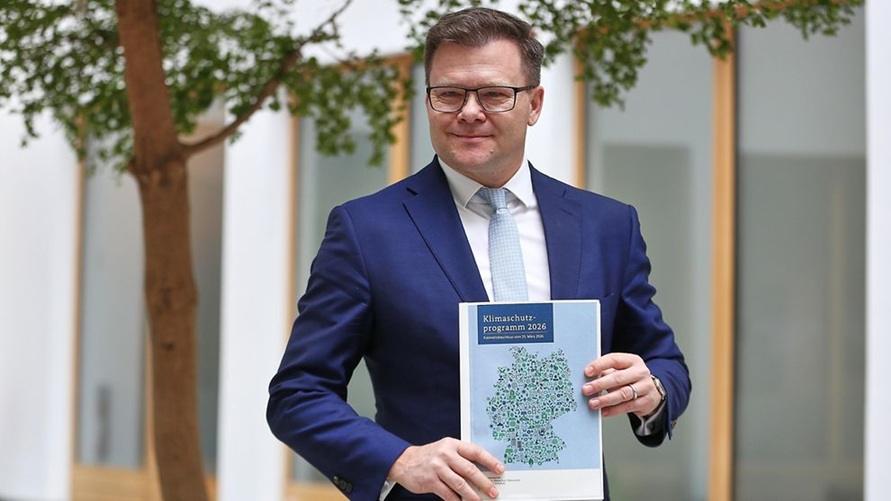
The government of Germany announced Wednesday the adoption of its new Climate Protection Program, setting out its action plan to achieve its goal to reduce emissions by 65% by 2030 on a 1990 basis, backed by €8 billion in investments over the next four years.
The program details 67 measures across the energy, transport, buildings and agriculture sectors, which the government said will save more than 25 million tons of CO2 per year by 2030. Notably, reflecting the shift in recent years in climate action towards protecting competitiveness, and the recent spike in energy prices, the government highlighted the program’s capability to support the economy to “become less dependent on highly volatile global market prices for fossil fuels,” as well as the greenhouse gas (GHG) reduction impact.
Noting that “the issue of climate protection has become far too polarizing in recent years,” Carsten Schneider, Germany’s Federal Environment Minister, said:
“This program will give a new boost to climate protection, making us less dependent on expensive and uncertain oil and gas imports. We are modernizing the economy, making society more resilient to crises, and helping nature to help us. What is at least as important to me is that we, as the Federal Government, have succeeded in developing this program without major controversy.”
Among the key measures outlined in the program, in terms of both GHG and fossil fuel consumption reduction, is a planned expansion of an additional 12 GW of onshore wind power, which the government said will provide electricity production equivalent to the current output of around 15-20 gas-fired power plants, significantly reducing use of natural gas and coal, and avoiding 6.5 million tons of CO2 emissions by 2030. The government added that the new planned tender rounds will enable Germany’s goal of reaching 115 GW of onshore wind power installed by 2030.
In the industrial sector, the program includes measures aimed at supporting investments in in the decarbonization of process heat and electrification technologies, such as heat pumps, with the initiatives expected to prevent at least 4.3 million tons of CO2 emissions, in addition to reducing natural gas imports by 2.5 billion cubic meters.
The plan’s transportation components include a new €3 billion subsidy program for electric vehicles, aimed at low- and middle-income individuals that would otherwise be unable to afford a new EV. The new funding program is expected to support up to 800,000 EVs, and to save more than 800 million liters of gasoline by 2030.
In the building sector, the new program’s measures include a new district heating package aimed at expanding heating networks and increasing the share of renewable energies and waste heat in the networks, which the government said will save the equivalent of approximately one billion cubic meters of natural gas, or 2.3 million tons of CO2 by 2030.
The new program also includes a series of agriculture and nature-focused initiatives, including funding to support switching from diesel-based agricultural machines to electric drives, and measures aimed at enabling forests, peatlands, and soils to contribute to climate protection by sequestering carbon.
Schneider added:
“With this program, the Federal Government is making significant progress. But I’m not naive. Further progress will be necessary, but also possible. Climate protection requires perseverance, reliability, and the willingness to continually adjust course as new needs, opportunities, and insights emerge.”