
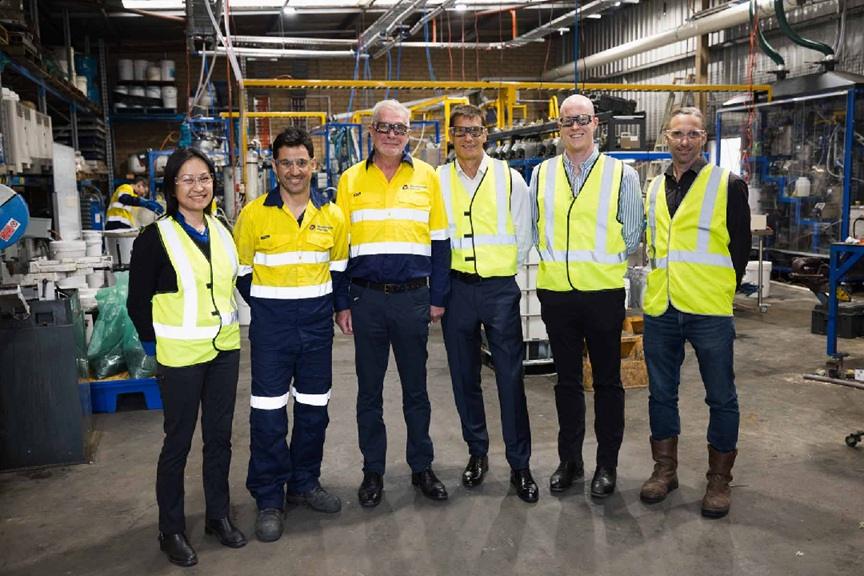
Battery recycling startup Renewable Metals announced that it has raised $12 million in a Series A funding round, aimed at accelerating the commercial deployment of its next-generation lithium-ion battery recycling solution.
Founded in 2020 by a team of expert West Australian metallurgists, Renewable Metals has developed a solution to recover critical minerals from old batteries to enable their re-use, with fewer steps and lower cost. The company said it that its alkali-based hydrometallurgical process to recover lithium, cobalt, nickel, copper, and manganese from end-of-life lithium-ion batteries, achieving over 95% recovery rates, including up to 30% higher lithium recovery than conventional methods, while reducing costs and environmental impact.
The technology can process multiple battery chemistries (NMC, LCO, LFP) and feed forms without pre-sorting or dismantling. This process eliminates intermediate black mass production while recycling reagents and wastewater and avoids problematic waste streams such as sodium sulphate, which can pose regulatory and cost challenges in regions such as the U.S. and Europe.
Luan Atkinson, CEO of Renewable Metals said:
“Our process changes the economics of battery recycling. By delivering high recovery at low cost without large, centralised facilities, we can build plants sized for near term feedstock, and scale with the market over time. This avoids capital intensive overbuild while enabling a distributed network close to feedstock sources globally, reducing the cost and complexity of transporting hazardous materials.”
The company said that the proceeds will support three core priorities, including enabling continuous 24/7 operations at its commercial prototype plant in Kewdale, Western Australia, accelerating engineering and design work for its first commercial-scale facility in New South Wales, and expanding its team across R&D, engineering and commercial functions.
Renewable Metals added that its Kewdale plant is expected to begin full operations from mid-2026 through early 2028, initially operating at a capacity of 960 tons per annum, increasing to 2,000 tons per annum. The facility is intended to generate near-commercial performance data to support the design of its first full-scale plant in the Hunter region.
According to the company, it is also advancing a Front End Engineering and Design (FEED) study for the New South Wales facility, aimed at establishing a blueprint for modular, lower-cost plants that can be deployed globally.
The round was oversubscribed and upsized from an initial $8 million target, bringing total funding secured to over $38 million since inception, including support from the Australian and UK governments, the company said.
The funding round was led by the Clean Energy Finance Corporation, managed by Virescent Ventures and included participation from existing investors the Neglected Climate Opportunities, European Metal Recycling (EMR), and Investible, alongside new investor Climate Tech Partners.
Blair Pritchard, Partner at Virescent Ventures said:
“Processing NMC and LFP together has been the unsolved problem in battery recycling. Conventional approaches require separate lines for each chemistry, duplicating capital and operating costs and limiting flexibility as the market evolves. Renewable Metals has solved for that. Their single-line process handles both chemistries together, which is technically non-trivial and commercially significant as LFP’s share of the market continues to grow. Combined with a low-capital modular plant design, the company’s platform is genuinely deployable at scale.”