
Somewhere on the back nine at Steyn City on Thursday morning, two tall men in cut-off denim and dreadlocks, covered in tattoos, strolled through a golf tournament as if they had always belonged there. That’s because they did.
Jake Jones noticed them. The League’s Senior Vice President of Impact and Sustainability pointed them out unprompted – long after the conversation had moved on to carbon emissions and supply chain KPIs.
“You can’t do that anywhere else,” he said. “You can’t just rock up to a golf event and be yourself. That, for me, is non-negotiable.”
It may seem a minor detail, but it captures something essential about what LIV Golf is trying to build, and why its approach to sustainability and community impact is worth paying close attention to.
Jake Jones sat down with Liam Marais, Head of Global Newsdesk Operations at ESG News, on the opening day of LIV Golf South Africa for a wide-ranging conversation about what it actually means to run a global sporting tour responsibly. Not the press release version. The real one.
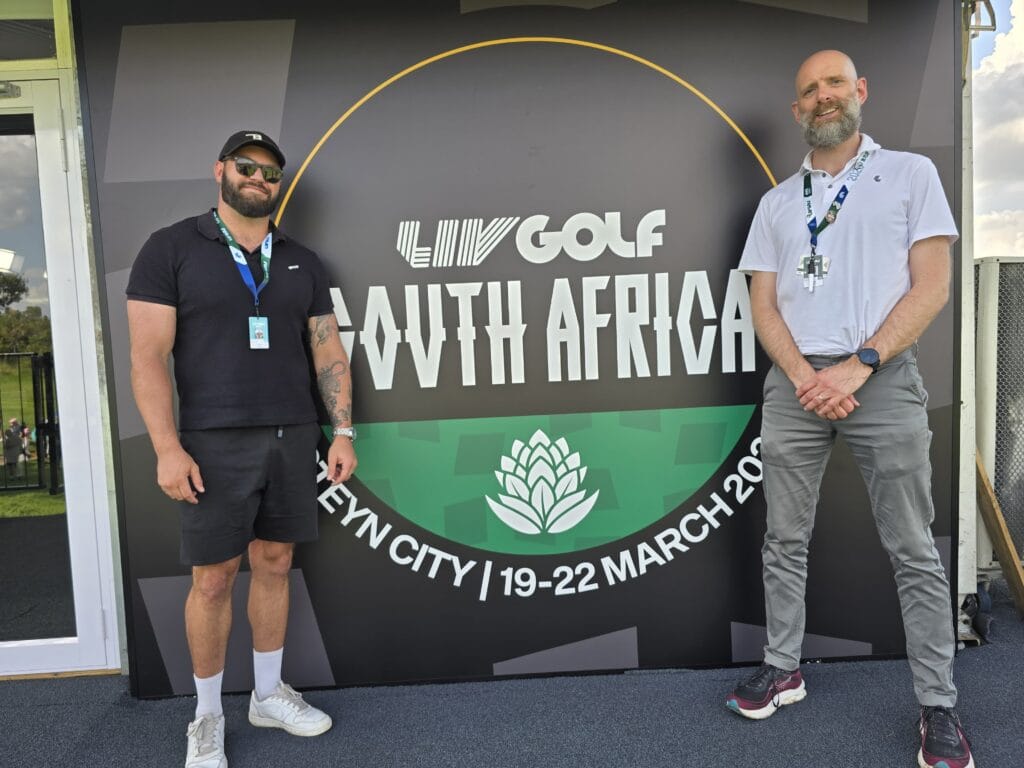
Jones joined LIV Golf in 2022, arriving at what he describes as a rare opportunity – building an impact and sustainability function from scratch, without the burden of unpicking decades of legacy systems. Three and a half years on, LIV Golf has become the first golf league, tour or major body in the world to achieve ISO 20121 accreditation (the international standard for sustainable event management) and it has received GEO certification across 13 of its 14 global events to date.
What emerged from the conversation was a picture of a league thinking carefully, and sometimes uncomfortably, about the gap between ambition and execution.
One Standard, Fourteen Very Different Realities
The first thing Jones wants to disabuse people of is the idea that sustainability looks the same everywhere. Across LIV Golf’s 14 global events, spanning Europe, Asia, the Americas, the Middle East and now sub-Saharan Africa, the infrastructure, regulation, supply chain maturity and even cultural expectations vary dramatically.
In Europe, he explains, the groundwork has already been laid. “Environmental regulation is pretty strong. The background of sustainable events is more than a decade old. The supply chain isn’t upset when you say ‘What are your options?’ It’s just expected. And the same with the fan base. They’d walk into one of our events in the UK or Spain and expect to see three different trash cans for waste separation.”
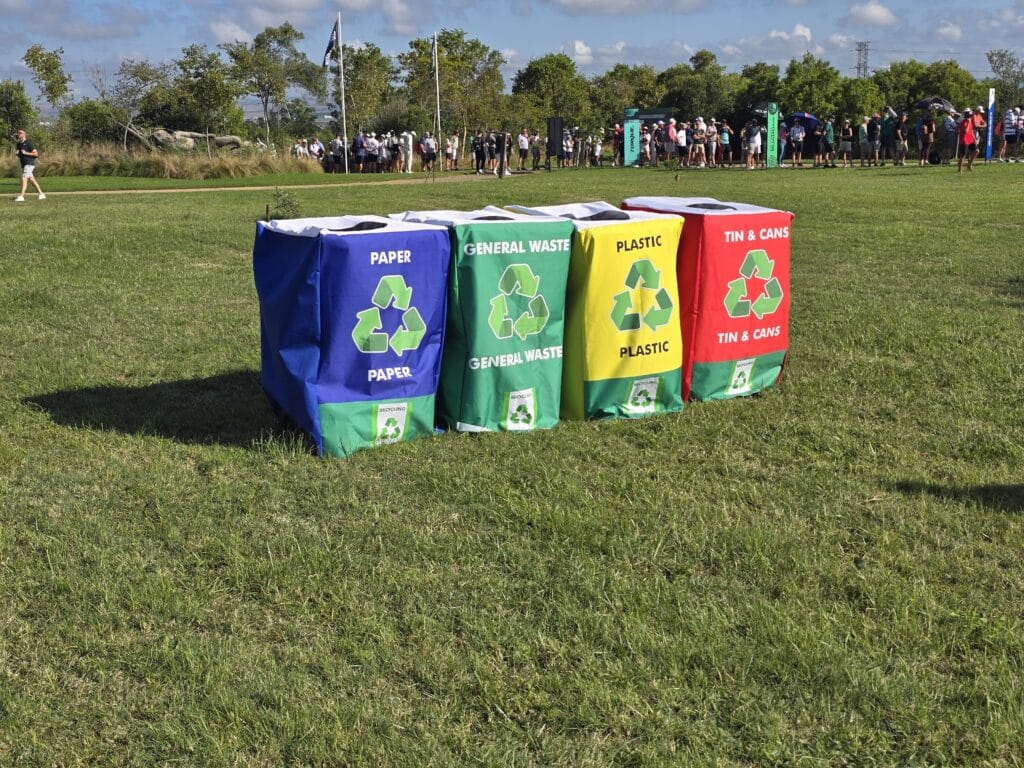
Other markets present a harder road. In some regions, recycling infrastructure barely exists at a household level, vendors have operated without sustainability requirements for decades, and state-level regulation has never forced the issue. The supply chain education required, Jones says, has been one of the steepest challenges since he joined.
Rather than mandating identical standards everywhere (which he acknowledges would be unrealistic), LIV Golf has embedded sustainability criteria directly into supplier contracts. Vendors must demonstrate progress, propose alternatives, and work toward targets, even where those targets need to flex year by year.
The Energy Problem: Why Behaviour Change Comes First
Power is where the conversation gets granular, and where Jones is most candid about the tension between aspiration and reality.
LIV Golf’s ambition is to progressively reduce the fossil fuel share of its energy mix. Its UK and Spain events now run on 100% HVO biofuel. Singapore operates at 40 renewable. But biofuel logistics are complex, and costs vary wildly by region.
“If the freight and transport costs to get HVO from one continent to another outweigh the benefit, and it’s not just cost but the emissions you emit just by shipping it, then you think, well, we’re probably better off finding efficient ways of using diesel.”
In those markets, the answer starts with behaviour change: switching generators off when no one is on that side of the course, upgrading to Gen 5 equipment that auto-regulates, and layering in solar for partial load relief. It is unglamorous work. It also saves money, which, Jones notes with some pragmatism, is often the more persuasive argument with suppliers.
South Africa brings its own specific complications. Load shedding, the rolling power outages that defined daily life in South Africa for several years, has largely eased. But energy security remains a live concern for anyone planning to power a world-class sporting event across a vast, complex site. Jones was frank about where things stand: “I’m not the expert in energy security. I’ve got to work with the local power provider. Maybe it’s a diesel generator for now, because we know that’s going to provide the most stable power, but we’ve got to move it forward over the next two or three years.”
It is the kind of honesty rarely heard from a sustainability executive at a major sports organisation. The goal Jones has set for South Africa is clear: within a few years, make this the most sustainable golf event on the continent. The path, he admits, is still being mapped.
From Philanthropy to Programme: A Different Model of Community Impact
If the energy conversation is about pragmatic incrementalism, the community impact story is where Jones becomes most animated.
He is deliberately moving away from what he calls “Classic old school sport philanthropy” — the model where an organisation rolls into a city, writes a large cheque, takes a photograph and never returns. “I don’t know where that money goes. I give it away. That still has a place in some sports. What I’m more interested in is something built into a programme that measurably affects lives.”
In Johannesburg, that philosophy is taking shape through the Southern Guards Foundation’s Academy Development Programme. Forty children from Diepsloot, a densely populated township of over 350,000 people located adjacent to the Steyn City tournament venue, are enrolled in a twelve-month programme combining weekly golf sessions with life skills education, mentoring, and resilience coaching.
“It’s not to develop them to be the next great golfer,” Jones said. “They’ve never held a golf club before, most have never left Diepsloot before. What it actually is, is to bring them on course once a week for a whole year. That’s fifty-two times. The players will get involved. But for fifty-two weeks, they’ll get golf tuition. Whether they’re any good or not doesn’t really matter. It’s baking in the mentoring, the coaching, the resilience, the life skills, with one eye from the coaches on, how is this helping you as an individual?”
Alongside the academy, LIV Golf is contributing $100,000 to the Steyn City Foundation’s Growzone programme, a network of urban nurseries that currently feed three thousand children in Diepsloot with home-grown fruit and vegetables. Jones wants to double that capacity. Then go further: help commercialise the produce so it can be sold at future tournament events, with revenue cycling back into the community.
“I would love us to get some apprenticeship programmes going. Sixteen, eighteen, twenty-year-olds from Diepsloot who perhaps have fallen out of education, into the nurseries, giving them some basic education on horticulture. Because those skills are transferrable, those skills they can use anywhere.
The Quiet Work Nobody Talks About
Some of LIV Golf’s most tangible contributions are the ones it does not publicise. At the end of every event, unused childcare supplies provided by LIV Golf (nappies, wet wipes, toys and changing mats) are collected and donated to local nurseries or mothers’ charities. In South Africa, that means a partner organisation in Diepsloot And to a mother in Diepsloot who may not be able to afford what she knows her child needs, these gestures make a world of difference.
At Steyn City, approximately 230m² of PVC signage will be donated to female-led micro-businesses to be upcycled into eco-shopping bags and future event materials. At a previous event in Adelaide, 17 tonnes of carpet from hospitality structures were cleaned and redirected into social housing. “Those social housing communities might not know where that carpet came from,” Jones said. “But we do.”
“We don’t lead on that. It’s just what we do to put a sustainable event on. But if you repeat it fourteen times over a year, suddenly you realise that’s quite a lot.”
It is a philosophy of compounding small actions over scale. And across 14 events a year, the scale adds up.
RELATED ARTICLE: LIV Golf Indianapolis Achieves 84% Waste Diversion, Moves Toward Zero Waste By 2026
Measuring Lives, Not Dollars
Perhaps the most striking element of LIV Golf’s approach is how it has chosen to measure itself. Jones is openly critical of the sports industry’s tendency to declare dollar amounts donated as a proxy for impact.
“Sport loves a dollars-donated target. I find that crude and difficult to talk about. What I like is a metric we’ve created and live by: lives impacted. It requires more measurements – you have to be more robust. You have a spectrum of shallow impact versus deep impact. A meal donated can make a difference for a day. A twelve-month golf programme can build life skills that will last a lifetime. That’s the difference between shallow and deep impact. Let’s measure ourselves on lives impacted, not dollars donated. Because who cares how much you donate? If it impacts a life, that’s more important.”
Lives impacted is now one of LIV Golf’s top-level corporate metrics, sitting at the apex of the business’s performance framework and cascading into departmental and individual KPIs across every function, including finance and legal. Every business unit carries a sustainability target. The next step, Jones said, is individual-level accountability, though he is clear-eyed that this requires sustained cultural change before it can meaningfully land.
There is also a broader evolution underway in how Jones thinks about the language itself. He has moved from CSR to ESG to what he now calls simply impact and sustainability. ” I think the next iteration is creating social cohesion through conversation at a local level. Sport has always broken down barriers. But at grassroots level, we can stop those barriers from forming in the first place.”
What Comes Next
For all the ambition, Jones keeps returning to the importance of this first year in South Africa as a foundation rather than a finished product. The site is vast and logistically complex. The supply chain is new. The energy infrastructure needs development. The community relationships have only just begun.
“The world is in a very difficult place right now and will be for the next ten years, and there are barriers going up left, right and centre. Sport has always broken down some of those barriers. But at grassroots level, we can stop those barriers from forming before they start, using golf, using sport, which is about inclusion, conversation, bringing communities together to talk who then realise, ‘Oh, actually you’re not too different to me.’”
The near-term goal is concrete: make LIV Golf South Africa the most sustainable golf event in the country. Build from this year, learning what the local market needs, what the supply chain can support and what the community actually wants, into something that outlasts the tournament by years.
And back on the course, two men in cut-off denim watch the golf. They do not know they are part of the story. But they are.
“Each event, we increase the percentage share of renewable energy or reduce fossil fuel energies, whilst ensuring what you’re seeing is world class,” Jones said. “That’s the journey. It may take time, but it’s worth it.”

The post Beyond the Fairway: How LIV Golf Is Rewriting the Playbook on Sustainability and Community Impact appeared first on ESG News.