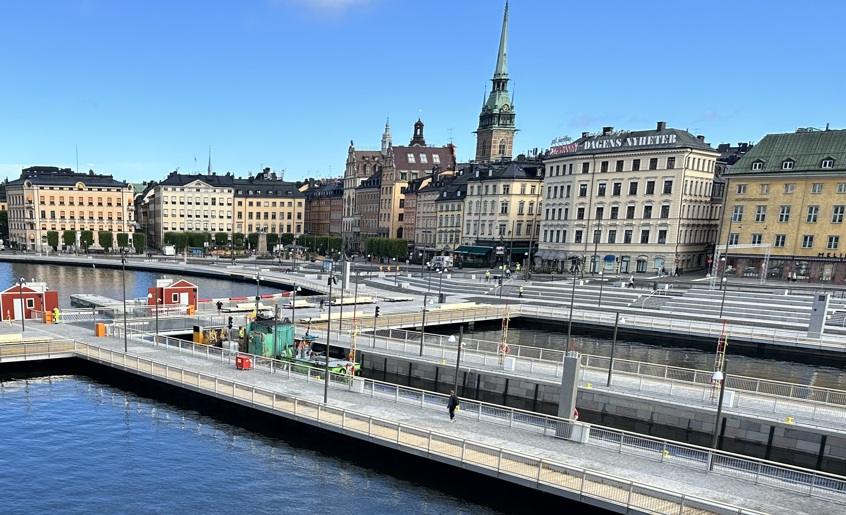
The City of Stockholm announced that it has entered into a long-term 750,000-tonne carbon removal deal with Swedish energy company Stockholm Exergi, making the city the fifth largest buyer of permanent carbon removals globally.
Under the new agreement, the City of Stockholm will purchase the equivalent of 50,000 tonnes of carbon removal annually for 15 years from Stockholm Exergi’s bio-energy with carbon capture and storage (BECCS) project at its bio-cogeneration plant at Värtan, Stockholm.
Stockholm Exergi is jointly owned by the City of Stockholm and Ankhiale, a consortium of leading European pension funds.
Stockholm Exergi has started construction on the BECCS facility, anticipated to be capable of capturing and permanently storing 800,000 tonnes of CO2 annually. The project is expected to begin operations around 2028.
The facility aims to bring together the bioenergy-based combined heat and power plant fueled by residues from forestry, sawmill and pulp and paper production, with a carbon capture and storage process that captures CO2 in the plant’s flue gases, and cools and compresses it into liquid form, for transport and permanent storage in sedimentary bedrock below the North Sea floor, where the liquid CO2 mineralizes over time.
The transaction follows Stockholm Exergi’s landmark agreement with Microsoft in 2025 for more than five million tons of permanent carbon removals, described by the companies as the world’s largest such agreement to date.
Anders Egelrud, CEO of Stockholm Exergi said:
“The City of Stockholm has long been at the forefront of the climate transition. They are now continuing to show the way for how municipalities, companies and others should act by combining strong emission reductions with the purchase of permanent negative emissions. At the same time, they are becoming part of building a new industry and creating a market for negative emissions.”
In its Environmental Programme and Climate Action Plan, the City of Stockholm has established the goal of becoming climate positive by 2030 and fossil fuel-free by 2040, requiring territorial emissions within the city boundaries to decrease sharply by 2030, and the removal of greenhouse gases to exceed emissions.
The city said that its investment in carbon removals complements its efforts to reduce fossil emissions and aims to counterbalance emissions that are very difficult or too costly to avoid, such as hard-to-abate emissions from construction materials and emissions linked to wastewater treatment.
Stockholm Mayor Karin Wanngård said:
“The city of Stockholm will be territorially climate positive by 2030 and completely free of fossil fuels by 2040. Through the purchase, Stockholm takes a global leadership role among climate-ambitious cities and becomes the fifth largest buyer in the world of permanent minus emissions. It is an important signal in times when the green transition needs to accelerate to counteract the climate crisis.”