
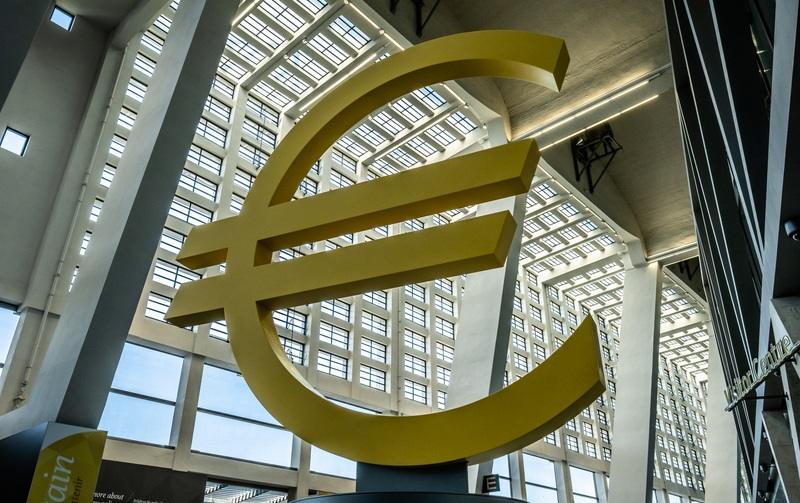
The European Central Bank (ECB) revealed that it has started the application of a new “climate factor” in its collateral framework, enabling the central bank to adjust the assigned value of assets pledged by banks as collateral for loans based on their exposure to climate transition risks.
The rollout follows announced plans for the climate factor by the ECB last year, following stress tests performed on the Eurosystem balance sheet, which indicated that the value of financial assets can be directly affected by climate change-related uncertainties, and that an unexpected drop in value caused by a climate shock could result in financial losses for the Eurosystem.
With the application of the new climate factor, the ECB can now adjust the “haircut” it applies when assessing the value of corporate bonds used as collateral in lending to banks based on climate risk, lowering the amount that the system would be willing to lend against those assets.
In a blog post discussing the new climate factor, the ECB said:
“Put simply, if a corporate issuer is more exposed to future climate transition shocks, a bank may be able to borrow less against the same value of bonds.”
The new move forms the latest in a series of measures initiated by the ECB following a 2022 announcement that it would begin incorporating climate change considerations into its monetary policy framework, with other actions including the decarbonization of its portfolio of corporate bond holdings over time, and the introduction of climate-related disclosure requirements for collateral.
In the blog post, the ECB expanded on the approach it is taking in applying climate risk considerations in the collateral framework, including noting that it utilizes forward-looking scenario analysis to assess the impact transition risks, as it is unable to rely on historical data, as “many of the future effects of climate change are unprecedented.”
The ECB said:
“Climate change introduces unprecedented, uncertain and potentially severe economic and financial consequences for firms that may not be reflected in the historical price data that is used to calibrate asset haircuts. For example, unexpected transition shocks linked to the move towards a low-carbon economy can affect firms’ business models, profitability, and the value of the assets they hold. Such shocks may occur in reaction to changes in climate policies, technological developments and shifting consumer preferences.”
The climate factor is based in part on an “uncertainty score” for each corporate bond that can be used as collateral, comprised of considerations including a sector-level “stressor” component that captures the potential impact of a transition shock on financial asset values for different sectors, a firm-level “exposure” component that incorporates factors including company GHG emissions, decarbonization targets and the quality of climate-related disclosures, and an asset-level “vulnerability” component.
Based on these components, the ECB noted that the assigned value of bonds may be more affected if by the issued by firms “with higher emissions, weaker transition plans or less comprehensive climate-related disclosures.” The ECB also noted that the utility, materials and transportation sectors may be subject to a relatively large reduction in collateral value, due to their high transition exposure, capital intensity, regulatory sensitivity and reliance on fossil fuels.
The post said that the ECB will regularly review the climate factor, including its scope and calibration, to reflect new data, regulatory developments and advances in risk assessment capabilities, adding that the immediate effect of the climate factor on banks is expected to be limited, given the current environment of low borrowing levels and the limited use of corporate bonds as collateral.
Notably, the Bank of England (BoE) also recently announced that it will also begin integrating climate transition-related risk factors in its methodology for valuing corporate bonds pledged by banks as collateral.