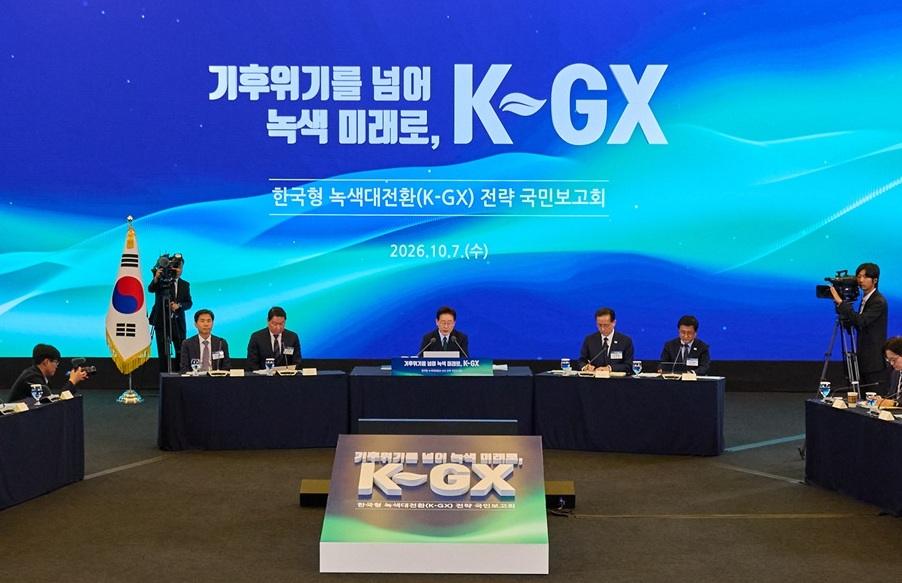
The Government of South Korea announced the launch of its new Korean Green Transformation (K-GX) Strategy, including plans to mobilize 1,000 trillion won (USD$747 billion) over the next ten years towards the achievement of its climate goals, with a focus on key areas including industrial decarbonization, renewable energy, and clean mobility.
According to the government, the key objective of the new plan is to systematically decouple economic growth from carbon emissions, enabling the country to meet its mid-to-long-term climate commitments while protecting its global industrial competitiveness.
Finance Minister Lee Hyoung-il said:
“The K-GX Strategy is not just an environmental policy; it is an absolute structural rebirth of Korea’s industrial landscape. By combining aggressive fiscal backing with regulatory relief, we are giving our core manufacturing sectors the predictability and capital they need to lead the global green economy.”
The new strategy envisions a multi-tiered financing framework to meet its capital mobilization goal, targeting 200 trillion won of government investment directly allocated from state budgets to fund green infrastructure, R&D and public-sector transition initiatives, 570 trillion won of state-backed climate finance in the form of low-interest loans, green bonds, and credit guarantees, and 230 trillion won that is expected to be mobilized through private-sector projects, supported by regulatory incentives and public-private partnership (PPP) frameworks.
Key focus areas of the strategy include the decarbonization of high-emitting sectors, with priority given to industries including steel, petrochemicals and refining, cement, and semiconductors & displays; renewable energy expansion, including a goal to scale domestic renewable energy infrastructure to 100 GW, with an emphasis on offshore wind and utility-scale solar, alongside grid modernization, and; clean mobility, with a target to have zero-emission vehicles account for more than 70% of new vehicle sales by 2035, and plans to phase out tax subsidies for internal combustion engines while building out national ultra-fast charging networks.
In a statement announcing the launch of the new strategy, South Korea’s Ministry of Climate, Energy and Environment said:
“This framework guarantees that South Korea will firmly adhere to its global carbon neutrality milestones while actively building domestic green jobs and securing the next generation of energy self-reliance.”