
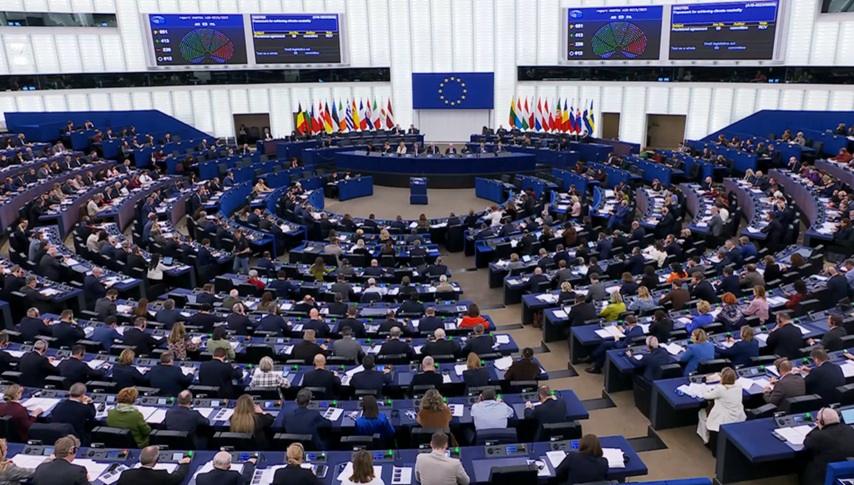
The European Parliament announced Tuesday the adoption by lawmakers in a 413 – 226 vote of amendments to the EU Climate Law requiring the EU to reduce greenhouse gas (GHG) emissions by 90% by 2040.
The vote, however, followed an agreement between Parliament and the European Council which required the introduction of several flexibilities in the Climate Law to put the new 2040 target in place, including allowing for the use of international carbon credits for up to 5% of the GHG reductions, and conducting a review every 2 years, which could result in changes to the target in the future, based on factors including energy prices and technological progress.
The EU Climate Law was initially adopted in 2021, and set into legislation the EU goal to reach climate neutrality by 2050, as well as the EU’s current interim target to reduce net GHG emissions by at least 55% by 2030 compared to 1990.
In a recent update, the Commission reported that the EU is nearly on track to hit its 2030 climate goal, and noted that it has already achieved a GHG emissions reduction of 37% as of the end of 2023 on a 1990 basis.
The Commission released a proposal to amend the law in July 2025, introducing a new target to reduce GHG emissions by 90% on a 1990 basis, and adding the ability for international carbon credits under Article 6 of the Paris Agreement to be used from 2036 to contribute up to 3% of the 90% reduction target.
Following concerns raised by some member states regarding the EU’s global competitiveness and the economic impact of the proposed update to the climate law, several flexibilities had to be added for lawmakers to reach an agreement on the new target.
Among the key changes from the Commission’s proposal in the agreement was an expanded role for carbon markets, with the agreement allowing for international carbon credits to contribute up to 5% of the new goal from 2036, effectively requiring actual domestic reductions of 85% by 2040. Notably, the international carbon credits can only be used to address emissions that are not covered by the EU’s ETS (Emissions Trading System) carbon pricing system, and can only come from countries with climate targets and policies aligned with the Paris Agreement’s targets, according to the agreement.
The agreement adopted Tuesday by MEPs also requires the Commission to assess progress towards the 2040 target every two years, considering factors including the most recent scientific data, technological developments, energy prices, the level of net removals and the EU’s international competitiveness, with the Commission mandated to propose revisions to the Climate Law if appropriate, including potentially modifying the 2040 goal.
In addition to approving the new goal, the vote also approved a one-year delay to the EU’s revision to the ETS, or ETS2, that was included in the agreement. ETS2, initially planned to be launched in 2027, will extend the EU’s carbon pricing system to new sectors, including fuel used for road transport and for heating buildings. The agreement also added flexibilities to ETS2, including providing member states with the ability to compensate for shortfalls within individual sectors to meet climate goals.
The amendments to the Climate Law will still need to be approved by member states in the EU Council before entering into force.