The UK government announced today the release of its proposed seventh carbon budget, including a target to reduce economy-wide emissions by 87% by 2040, on a 1990 basis.
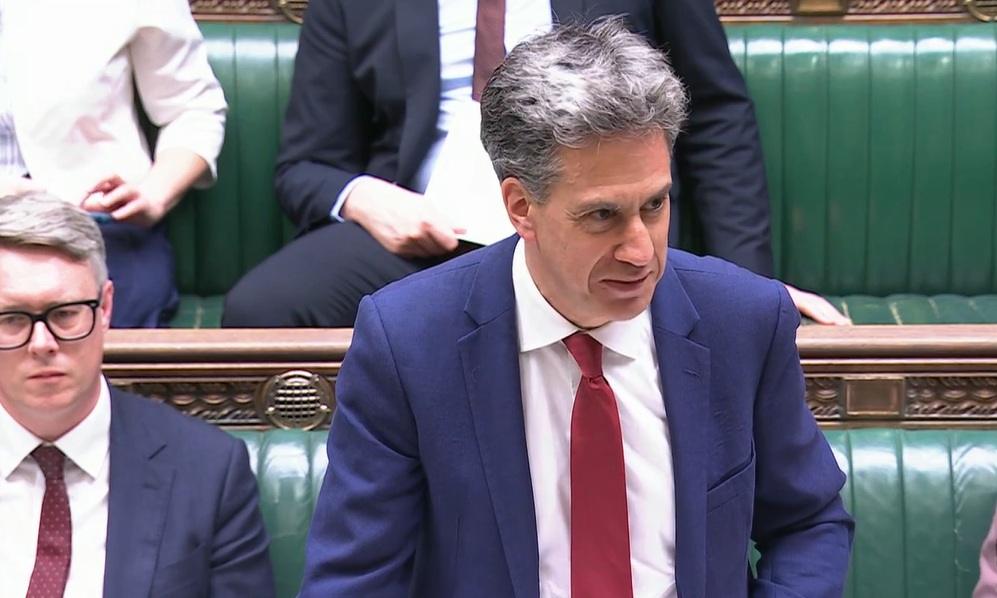
In his statement to Parliament introducing the new carbon budget, while noting the new target’s alignment with the UK’s goal to reach net zero by 2050, Energy Secretary Ed Miliband highlighted the in particular the benefit of substantially reducing the economy’s exposure to fossil fuel price shocks.
Miliband said:
“As Britain faces the second fossil fuel shock of the decade, the only way to protect family and business finances is to drive for clean homegrown power that we control.”
Carbon budgets are 5-year caps on greenhouse gas emissions (GHG) levels, required under the UK’s Climate Change Act 2008, with the 7th carbon budget limiting the volume of GHG emissions to 535 MtCO2e for the 2038 to 2042 period.
The UK has reduced greenhouse gas emissions by approximately 54% as of 2025, according to a recent analysis released by the UK’s Department for Energy Security and Net Zero (DESNZ), with the pace of emissions more than doubling since the introduction of carbon budgets in 2008. Key drivers of the progress to date include expansions in renewable power, and the phasing out of coal in the electricity sector.
The new 87% emissions reduction target aligns with the carbon budget proposal released last year by the Climate Change Committee (CCC), the UK government’s climate advisor, in its recommendation to the government.
According to the CCC’s analysis, achieving the targets set out in the carbon budget will require a significant reduction in emissions across sectors including surface transport, buildings, industry, and agriculture. While the bulk of emissions reductions through 2037 would focus on energy supply, by the 7th budget, the focus would shift to areas including buildings and surface transport, and later to tackling agriculture and land use emissions.
While requiring substantial up-front investments, the CCC’s analysis also estimated that the UK should start experiencing net savings during the seventh carbon budget period relative to a high-carbon economy, driven largely by the replacement of fossil fuel technologies with more efficient, low-carbon alternatives.
In a statement released following the introduction of the carbon budget, Nigel Topping CMG, Chair of the Climate Change Committee, said:
“The Committee is delighted that the Government have accepted the CCC’s advised level for the Seventh Carbon Budget. The lower-cost, energy-secure future is electric – so we hope to see the Government plan to accelerate electrification, in particular by making electricity cheaper.”
Miliband said that a delivery plan outlining the pathway to delivering the new targets will be released “as soon as is reasonably practicable” once Parliament approves the carbon budget.