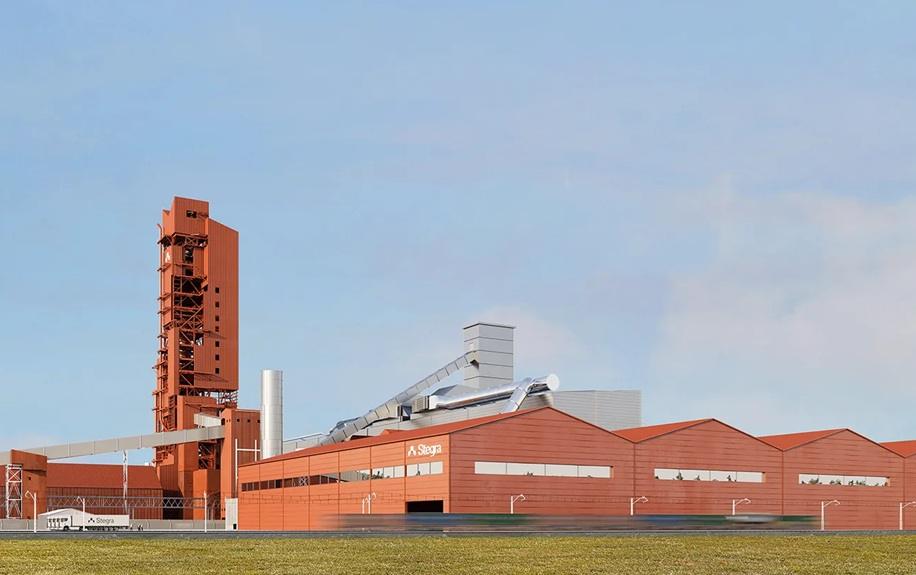
Google announced an agreement with green iron and steel maker Stegra for the purchase of environmental attribute certificates (EACs) connected to the production of near-zero emissions steel from Stegra’s upcoming plant in Sweden, with the deal aimed at helping Google to address emissions from its operations, and supporting Stegra in the development and early operation of the plant.
Founded in 2020, Stegra is building the world’s first large-scale green steel plant in Boden, aimed at producing 5 million tonnes of green steel annually. The company’s process utilizes hydrogen produced using green power to remove the oxygen from iron oxide, avoiding most of the CO2 emissions normally produced, and uses electricity from 100% renewable sources for the energy requirements generated in the manufacturing process.
Stegra recently closed a €1.4 billion financing round to enable it to complete construction of the project, providing the company with a major lifeline, after having to slow project development pending the outcome of the financing process.
Under the new agreement, Google will purchase EACs from up to 91,000 tons of the steel produced in Stegra’s first year of production, with an ambition to add more volumes over the length of the agreement.
Stegra CEO Henrik Henriksson said:
“There are some players globally that can help move markets towards decarbonized products in an impactful way. Google is naturally one such player. Beyond the call to action to increase the supply of sustainably produced steel, we are also grateful that the team at Google chose to work with Stegra and support our first years of operations in this way.”
Google recently acknowledged that its “moonshot” climate goals, including its target to achieve net zero greenhouse gas emissions by 2030 are getting harder to reach, with the company reporting a 25% increase in Scope 3 emissions in 2025, driven largely by its AI infrastructure buildout, including its construction of data centers.
The company said that it can use the EACs from the new agreement to help address the steel-related emissions from its own operations, including the construction of datacenters, in addition to backing a mechanism that can support the scaling and financing of new industrial companies in clean tech, and investments in new sustainable technologies.
Adam Elman, Director of Sustainability for Google in Europe, the Middle East and Africa, said:
“Decarbonizing the most challenging sectors requires every tool in our toolbox. Alongside physical procurement, certificates are another vital mechanism. Having proven this model with clean electricity and expanded it to other areas like sustainable aviation fuel, we see green steel EACs as another promising lever to address industrial emissions and scale the clean technologies of the future.”