
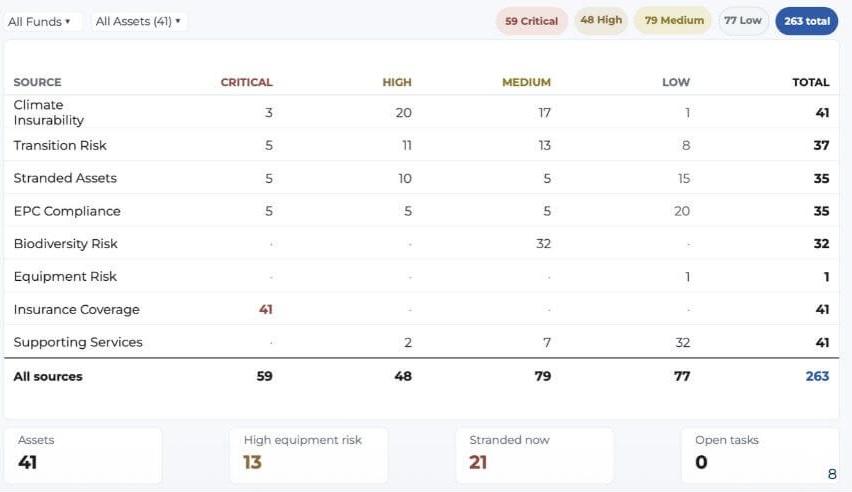
Sustainability and business risk software company ESG Playbook announced the launch of its new real estate dashboard, aimed at enabling real estate asset managers, investors and lenders to quantify climate, energy and retrofit risk for buildings.
According to ESG Playbook, the new dashboard enables users to identify the “true cost” of owning a building, allowing deal teams to rapidly screen large pipelines, see what a building capex will require beyond its asking price, and match the retrofit plan over 1,400 incentive programs across 52 countries. The company added that the solution will help investors, asset managers and lenders to identify potential concerns earlier and prioritize which properties warrant further due diligence.
Key features of the new solution include AI-assisted screening of high volumes of opportunities covering overall risk, strengths, red flags, data gaps, climate risk adjustments, NOI trajectory, tenant and rent roll sensitivity, and comparable transactions; stranded asset analysis, including projecting when a building falls out of alignment with CRREM decarbonization pathways, and calculating retrofit capex, stranding discounts, void risk, and an adjusted asset value; physical risk and surrounding-area resilience analysis indicating how hazards could affect the surrounding services, roads, and utilities of the asset; insurability and insurance intelligence; matching of specific equipment upgrades to incentives, tax credits, green loans, and transition funding; global real estate-specific regulation monitoring to track benchmarking and carbon tax modeling deadlines, and; building monitoring, tracking equipment lifecycle, energy performance, warranties, and servicing records.
ESG Playbook added that the dashboard connects to its carbon management tools supporting Scope 1, 2, and 3 reporting aligned with the GHG Protocol, TCFD, ISSB, and CSRD, EU Taxonomy and SFDR, in addition to supporting PCAF financed-emissions reporting for lenders.
Sonia Zugel, CEO and Founder of ESG Playbook, said:
“Real estate investors need to future-proof their portfolio for climate and transition risk with numbers they can defend. A deal team should be able to walk into an investment committee and say what the building will need, when it will need it, what funding can help pay for it, and where every figure came from.”