
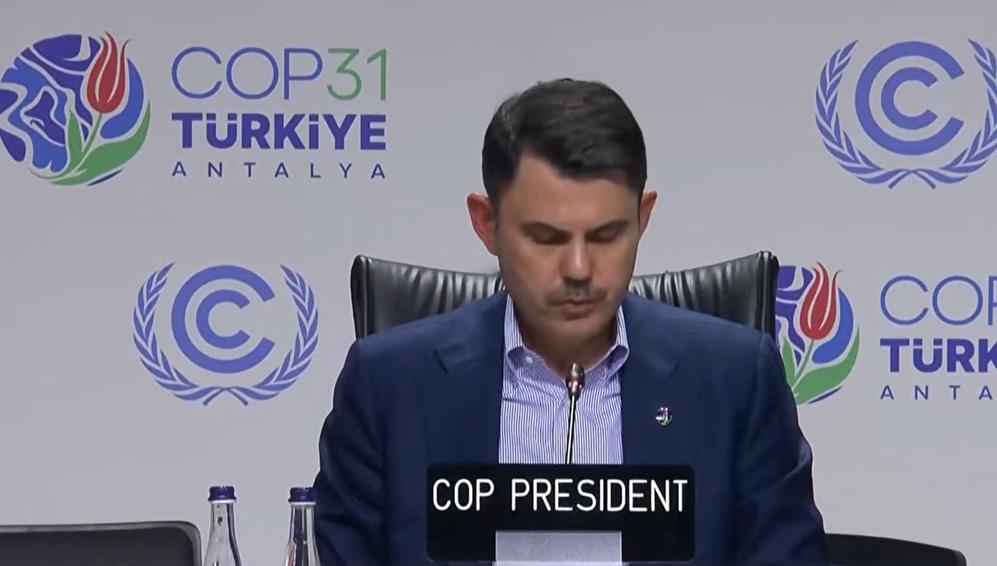
After a contentious negotiating session that extended past Friday’s deadline into early Sunday, the COP31 climate conference in Antalya, Turkey ended without a final agreement for the first time since 2009, with governments including the EU and UK refusing to sign a deal that failed to recognize the need to shift away from fossil fuels in order to fight climate change.
Other key contentious issues contributing to the collapsed talks included an inability to set a baseline for a global target for wealthy nations to channel financing to developing countries for climate adaptation, and the prominence of carbon capture as a strategy to mitigate climate change.
The 2026 UN-backed conference came in a year that saw global temperatures close in on 1.5°C above the pre-industrial average, and following a landmark UN report in September that concluded that the goal to limit global temperature increase to 1.5°C, identified as the threshold to avoid the most significant impacts of climate change, is now out of reach, and proposed a focus on actions to limit the overshoot and return to target levels by targeting net negative GHG emissions.
2023’s COP28 conference was the first to ever call for a global transition away from fossil fuels, but this call was not repeated in either of the 2 subsequent conferences, despite strong objections last year from the EU and UK.
After references to fossil fuels once again disappeared from draft texts late last week, the EU signaled that it would be willing to walk away rather than ratifying a deal. The EU also objected to the text’s heavy emphasis on carbon capture, utilization, and storage (CCUS). While a last-minute draft agreement was presented Sunday morning acknowledging the 1.5°C overshoot, making reference to the COP28 agreement, and scaling back the CCUS emphasis, it continued to omit an explicit reference to fossil fuels, driving the EU to walk, joined by the UK, which had been taking a more conciliatory, consensus-seeking tone during the conference.
According to Wopke Hoekstra, EU Commissioner for Climate, Net Zero and Clean Growth, while there was a “temptation… to muddle through,” the EU assessed that it was “better for climate action to draw a line in the sand.”
Hoekstra added:
“Unfortunately, the final text fell short of what is needed.
“It was backsliding on science. Science must underpin everything we do. It was also backsliding in terms of ambition. There was no willingness to recognise the transition away from fossil fuels and the link between fossil fuels and the planet heating up.”
The negotiations were also challenged by a failure in the proposed agreement to set a baseline to back up a commitment from last year’s conference to triple financing for poorer countries to adapt to climate change, with references from a draft earlier in the week to a pledge to reach at least $120 billion in annual adaptation finance by 2035 disappearing from subsequent versions of the agreement.
UK Secretary of State for Energy Security and Net Zero Miatta Fahnbulleh called the failure to reach an agreement “immensely disappointing.” In a statement on the COP31 outcome, the UK government said:
“The United Kingdom does not believe the cover decision proposed by the Presidencies meets the moment. We believe it moves us backwards on the science when we must accelerate implementation. It has compromised where it should have presented bold collective ambition on climate action.”