
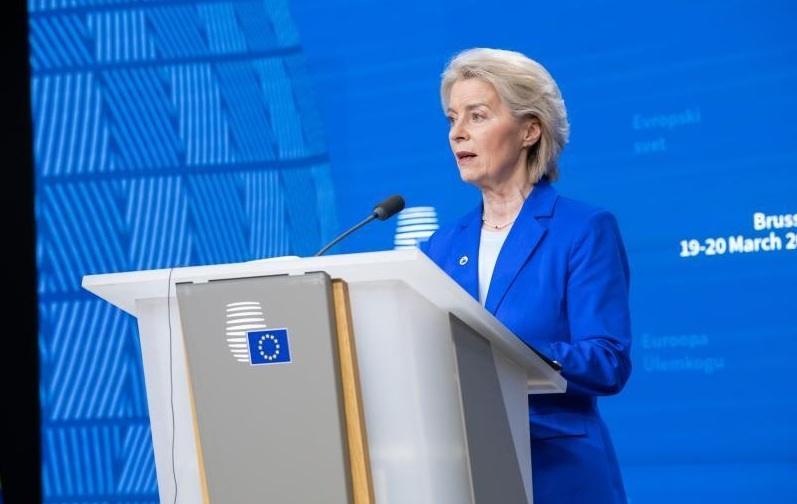
European Commission President Ursula von der Leyen unveiled a series of commitments aimed at addressing rapidly rising energy costs and driving investment enabling the development of clean, domestic energy sources, including plans to introduce revisions to the EU Emissions Trading System within the next few days, and to launch a €30 billion decarbonization and cleantech fund, funded by the ETS.
The Commission President’s commitments were announced at a press conference following the Euro Summit meeting with member states at the European Council, which focused largely on the ongoing Middle East conflict, and its impact on the European economy, and energy prices in particular.
Von der Leyen said:
“The war’s most immediate impact on Europe is on our energy. At present, the European Union’s physical security of supply is secure. However, Europe is not immune to global price spikes. As the conflict continues, energy prices continue to fluctuate. Just today, the gas price went up by 30% after attacks on Qatari gas infrastructure.”
The Emissions Trading System (ETS) is the EU’s internal cap and trade carbon pricing mechanism. Established in 2005, the ETS puts a price on carbon emissions for key GHG intensive sectors, including electricity and heat generation, oil refineries, steel, cement, paper, chemicals, and commercial aviation, among others.
As Europe has faced rising energy prices, first driven by the Russia-Ukraine war, and now exacerbated by the war in Iran, several member states have recently called on the Commission to review the ETS to help reduce pressure on industry, while von der Leyen has defended the system as an effective tool to drive reduced dependence on imported fossil fuels, accelerate the shift to cleaner energy sources and fund investments in decarbonization-focused technologies.
After the meeting on Thursday, however, while continuing to support the ETS, von der Leyen agreed to introduce changes to the carbon pricing system, acknowledging a “need to modernise it and make it more flexible.”
Von der Leyen said:
“The Emissions Trading System is working. It has massively reduced gas consumption. Because of that, it has reduced our dependency on imports of fossil fuels, and it has reduced our vulnerability. And it has driven major investments in the energy transition in the low-carbon energy sources like renewables and nuclear that are homegrown and give us independence. But we need to modernise it and make it more flexible.”
Near-term changes planned “in the next days” include updating the ETS’ benchmarks that determine the free allocations of emissions allowances to industry, and to “take into account the concerns of industry,” as well as to “increase the firepower of the Market Stability Reserve,” the mechanism that manages the supply of carbon allowances under the system to support price stability.
Longer term, von der Leyen said that the Commission is working on an ETS review, aimed at introducing “a more realistic trajectory,” and to extend free allowances for industries beyond 2034.
Von der Leyen also said that she plans to propose an “ETS Investment Booster,” a new fund with a €30 billion budget, aimed at supporting clean technology and decarbonization investments, which will be financed by ETS allowances. The booster fund will work on a “first come, first serve” basis to fund projects as soon as they are ready, and will guarantee access to lower-income member states, von der Leyen said.
The meeting notes released following the summit said that the Council “invites the Commission to present a review of the emissions trading system (ETS) by July 2026 at the latest.”