
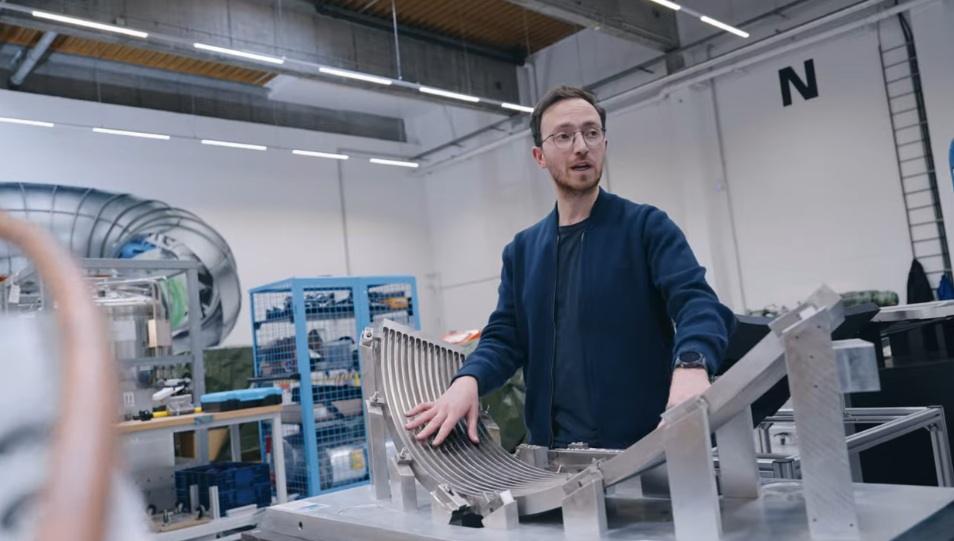
German fusion technology startup Proxima Fusion announced that it has raised €411 million (USD$468 million) in a new funding round, marking the largest-ever private investment in European fusion, with strategic investors including Google and RWE.
According to Proxima CEO Francesco Sciortino, the funding round comes as Europe is competing with the U.S. and China to be the first to achieve commercial fusion, with the financing establishing Proxima as the best-funded fusion company in Europe, and valuing the company at nearly €2.5 billion.
Sciortino said:
“Europe is racing with the United States and China to get to the first fusion power plant. Proxima’s financing demonstrates that Europe can not only invent breakthrough technologies, but also build globally competitive companies around them.”
Fusion, the process of combining two atoms to form a single atom to release energy, has been long referred to as the “Holy Grail” of clean and abundant energy production, given its potential to produce power from hydrogen – the most common element in the universe – without producing carbon emissions associated with fossil-fuel based power, and without the highly radioactive output of nuclear fission processes. Large scale fusion energy generation has been elusive, however, given the need to create extremely high temperatures and pressure.
Founded in early 2023 as a spin-out of the Max Planck Institute for Plasma Physics (IPP), Proxima is developing stellarators for fusion power plants. Stellarators are doughnut-shaped devices that magnetically levitate hot ionized plasma and heats it to extremely high temperatures to achieve fusion power. The company’s technology is based on the QI-HTS stellarator concept, which utilizes a magnetic confinement approach that eliminates current-driven instabilities and the risk of disruptions typical to other fusion approaches.
According to Proxima, the new financing will provide the company with the backing to build Alpha, a net-energy stellarator demonstrator near Munich. Alpha, targeted for completion in the early 2030s, is aimed at bridging fusion research and commercial deployment, and to ultimately enable Proxima’s first commercial stellarator fusion power plant, Stellaris, later that decade.
The financing marks the latest in a series of fusion-focused investments by Google, as the company’s AI infrastructure growth drives increasing power needs, and it looks to back technologies to provide an abundant source of carbon-free energy. One of Google’s “moonshot” climate goals is its 24/7 CFE ambition, to run its entire business on carbon-free energy (CFE), matching electricity demand with CFE supply every hour of every day, in every region where the company operates. The company recently acknowledged that its climate goals are becoming more difficult to reach as its AI infrastructure has been growing faster than the grid has been decarbonizing.
RWE’s investment follows a recent agreement with Proxima to partner on building the first stellarator fusion power plant on the site of a former nuclear fission power plant in Gundremmingen, Bavaria.
Sciortino said:
“Investors recognise both the urgency and the opportunity of what we’re doing and are backing us to develop a generational energy technology company.”
The financing round was led by XTX Ventures and East X Ventures, and also included participation from new investors KfW Capital, SPRIND and Burda Principal Investments and returning investors including Plural, UVC Partners, Balderton, Cherry Ventures, DST Global Partners, Brevan Howard Macro Venture, Lightspeed, DTCF, redalpine, Leitmotif, Elaia, CDP Venture Capital, Bayern Kapital, and the EIC Fund.