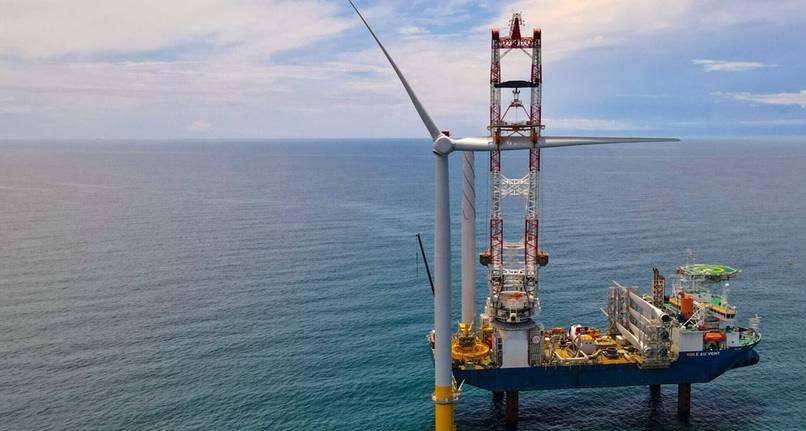
The U.S. Department of the Interior announced on Monday the immediate pause of leases for all large-scale offshore wind projects under construction in the U.S., citing “national security risks” potentially resulting from the projects.
The announcement will freeze the development five major projects along the U.S. east coast, representing nearly 6 GW of energy, that were set to enter commercial operation over the next 2 years, and follows a series of unsuccessful attempts by the Trump administration to halt large-scale renewable energy projects over the past year.
The paused projects include Vineyard Wind 1 off the coast of Massachusetts, Revolution Wind in offshore Rhode Island, Coastal Virginia Offshore Wind (CVOW) in offshore Virginia, and Sunrise Wind and Empire Wind 1, each off the coast of New York. The projects are mostly in advanced stages of development, with each expected to come online in 2026 or 2027.
Dominion Energy, the leaseholder and developer of CVOW, the largest of the projects at 2.6 GW, warned in a statement released after the order that the project “is essential for American national security and meeting Virginia’s dramatically growing energy needs,” and added:
“Stopping CVOW for any length of time will threaten grid reliability for some of the nation’s most important war fighting, AI, and civilian assets. It will also lead to energy inflation and threaten thousands of jobs.”
The Interior Department’s order marks the latest in a series of moves by the Trump administration to stop the development of renewable energy projects, starting with a Presidential Memorandum signed by Trump on his first day in office, indefinitely halting all federal approvals for wind energy projects. The order was recently struck down by a U.S. federal court, which ruled that it was “arbitrary and capricious and contrary to law.” The Interior Department also ordered a halt earlier this year on the Empire Wind project – which is included in the projects targeted in the new order – on the basis that “the Biden administration rushed through its approval without sufficient analysis.” The Empire Wind halt was reversed in May.
In its statement announcing the halt, the Interior Department said that the projects were being paused “due to national security risks identified by the Department of War in recently completed classified reports,” in order to give “time to work with leaseholders and state partners to assess the possibility of mitigating the national security risks posed by these projects.”
The Department also noted “national security risks inherent to large-scale offshore wind projects,” stating that “unclassified reports from the U.S. Government have long found that the movement of massive turbine blades and the highly reflective towers create radar interference called “clutter,” which “obscures legitimate moving targets and generates false targets in the vicinity of the wind projects.”
Following the order, however, Empire Wind leaseholder Equinor said that it has “coordinated closely with the federal officials on national security reviews” for the development of the project, “including with the Department of War.” Similarly, Revolution Wind and Sunrise Wind developer Ørsted said that the projects “secured all required federal and state permits following comprehensive, years-long reviews,” including working “closely and directly with the U.S Department of Defense Military Aviation and Installation Assurance Siting Clearinghouse to evaluate and address potential impacts to national security and defense capabilities from construction and operation” of the projects.
New York Governor Kathy Hochul called the announcement “another hit on New York” by “the job-killing Trump administration,” and said that she “doesn’t buy” the administration’s national security justification for the order, arguing that “reducing our reliability on foreign energy, like foreign oil, is a step toward our own energy future and that’s why creating our own renewable energy like offshore wind is an important part of our national security.”
Hochul said:
“We’re counting on half a million homes being powered by clean renewable energy from offshore wind next year, ready to launch something that has been anticipated for many years, we were finally about to get over the finish line.”