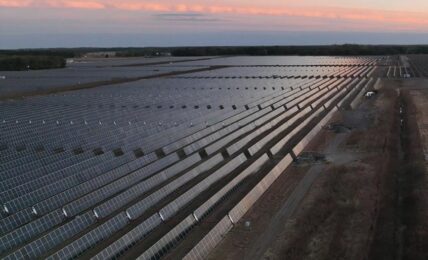
- The 25-megawatt Mulwala Solar Farm in New South Wales is nearing completion and preparing to connect to Australia’s grid.
- The project will add new renewable capacity to the National Electricity Market as data demand rises.
- Google says the solar farm supports its Digital Future Initiative and its aim to operate on 24/7 carbon-free energy.
Solar Power For Australia’s Digital Infrastructure
New South Wales is preparing to add new renewable power to Australia’s fast-expanding digital economy, as Google, AirTrunk and European Energy Australia move closer to launching the 25-megawatt Mulwala Solar Farm.
The project, first announced in 2023, is nearing completion and preparing to join the grid. Once operational, it will feed new clean energy capacity into Australia’s National Electricity Market. The development comes as cloud computing, artificial intelligence and data storage drive higher electricity demand across the region.
For Google, the project forms part of its Digital Future Initiative. That program links the company’s technology expansion in Australia with infrastructure, skills and energy investments. The Mulwala Solar Farm is designed to help match digital growth with new renewable generation, rather than relying only on existing grid capacity.
“Today, alongside AirTrunk and European Energy Australia, we announced that the 25-megawatt Mulwala Solar Farm in New South Wales is nearing completion and preparing to join the grid.”
Clean Energy Meets Data Centre Demand
The project brings together three different parts of the energy and technology system. Google is seeking to reduce the carbon impact of its operations. AirTrunk is a major data centre operator in the Asia-Pacific region. European Energy Australia brings renewable energy development expertise.
Together, the partners are positioning the solar farm as part of a broader shift in how digital infrastructure is built and powered. Data centres are becoming essential economic assets. They support cloud services, AI workloads, financial systems, public sector digitisation and enterprise operations.
At the same time, they are under rising scrutiny. Investors, regulators and customers increasingly want to know how these facilities manage electricity demand, grid pressure and emissions exposure.
“First announced in 2023, this project will add new clean energy capacity to Australia’s National Electricity Market.”
That point matters for executives. Corporate renewable energy procurement carries more weight when it helps bring new generation online. It can reduce emissions linked to operations while also supporting wider grid decarbonisation.
RELATED ARTICLE: Google DeepMind Launches APAC AI Accelerator To Scale Climate, Nature Solutions
Governance And Grid Implications
Australia’s energy market is still working through the complex transition away from fossil fuels. New solar, wind, storage and transmission capacity remain central to that shift. Corporate-backed renewable projects can help accelerate investment, especially when large energy users commit demand.
The Mulwala Solar Farm also reflects a governance challenge for technology companies. Digital services are growing quickly, but climate commitments now require clearer proof of energy sourcing. Buying renewable energy certificates is no longer enough for many stakeholders.
Google has set an aim to operate on 24/7 carbon-free energy. That target is more demanding than annual matching, as it focuses on clean electricity use every hour of every day. Projects such as Mulwala can help close the gap between climate ambition and operating reality.
“As part of our Digital Future Initiative, this solar farm helps match growing digital needs with new renewable energy, supporting Australia’s broader grid decarbonization. It also brings us closer to our aim of operating on 24/7 carbon-free energy.”
What Executives Should Watch
For C-suite leaders and investors, the project highlights a growing link between digital strategy and energy strategy. Data growth now carries direct ESG consequences. Companies using cloud, AI and digital platforms may face closer questions about the power behind those services.
Infrastructure investors will also watch how partnerships between hyperscalers, data centre operators and renewable developers evolve. These deals can reduce energy risk, support decarbonisation claims and create demand certainty for new projects.
The financing details were not disclosed in the source material. Even so, the commercial direction is clear. Large technology users are no longer only electricity buyers. They are becoming active participants in clean power development.
“By partnering with local and international experts, we’re showing how digital infrastructure can be built responsibly, ensuring the technology of tomorrow is powered by clean energy today.”
The Mulwala Solar Farm is modest in size compared with Australia’s largest renewable projects. Yet its strategic value sits in the connection between clean power and digital growth. As AI and cloud demand rise globally, that connection will become harder for boards, regulators and investors to ignore.
The post Google, AirTrunk And European Energy Australia Prepare 25MW Solar Farm For Grid Launch appeared first on ESG News.