
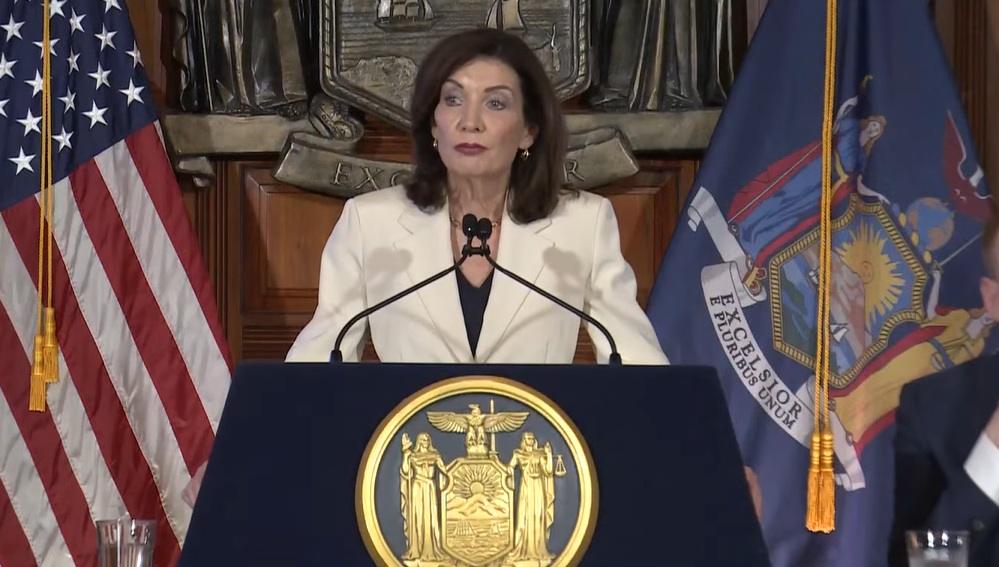
New York Governor Kathy Hochul announced an agreement with state legislators on the 2027 State budget, which will include significant changes to New York’s climate goals, including pushing back an already-passed date to adopt emissions reduction regulations, and replacing a 2030 economy-wide GHG emissions reduction goal with a new 2040 target.
The new budget deal follows warnings from Hochul earlier this year that the state’s climate goals had become “costly and unattainable,” and would impose “crushing costs on New York businesses and residents,” in light of geopolitical changes, including “a full-on assault on renewables and the tax incentives” by the Trump administration and Republican politicians.
New York’s 2019 Climate Act sets mandatory targets for the state to achieve at least 85% in economy-wide emissions greenhouse gas (GHG) emissions reductions by 2050, with the remaining residual emissions to be addressed through carbon removal and offsets, and an interim target of a 40% reduction by 2030.
The law also required New York’s Department of Environmental Conservation (DEC) to adopt regulations to enforce the emissions targets by 2024, which the state has not yet done. In late 2025, the Supreme Court of New York ordered DEC to issue the regulations by early 2026, unless the law is changed.
Hochul had previously said that she had proposed to amend the law to push out the requirement to issue regulations to reduce GHG emissions to the end of 2030, with the new regulations to be tied to a new 2040 emissions reduction target, while retaining the Climate Law’s 2050 goal.
In a presentation announcing the budget deal, the Governor’s office revealed a compromise, with a new requirement to be put in place mandating the regulations by introduced by 2028, instead of the proposed end of 2030.
A government spokesperson said that the new goal will target a 60% reduction in emissions by 2040, with the law requiring regulations in 2028 to reach that target.
The deal will also change accounting methods used by the state to measure greenhouse gas emissions from a 20-year standard to a 100-year standard, which the Governor argued was more commonly used. The change will effectively make the achievement of emissions reduction goals easier.
Hochul said:
“New York has led and will continue to lead on clean energy and climate, but reality has been harsh. We cannot meet the current timelines without driving energy costs higher. The facts bear that out, and I cannot let that happen. We have to strike the right balance between our clean energy ambitions and the affordability pressures that real New Yorkers are facing right now.”
“Let me be clear, this does not diminish our commitment to forging a clean energy future for our children and grandchildren.”